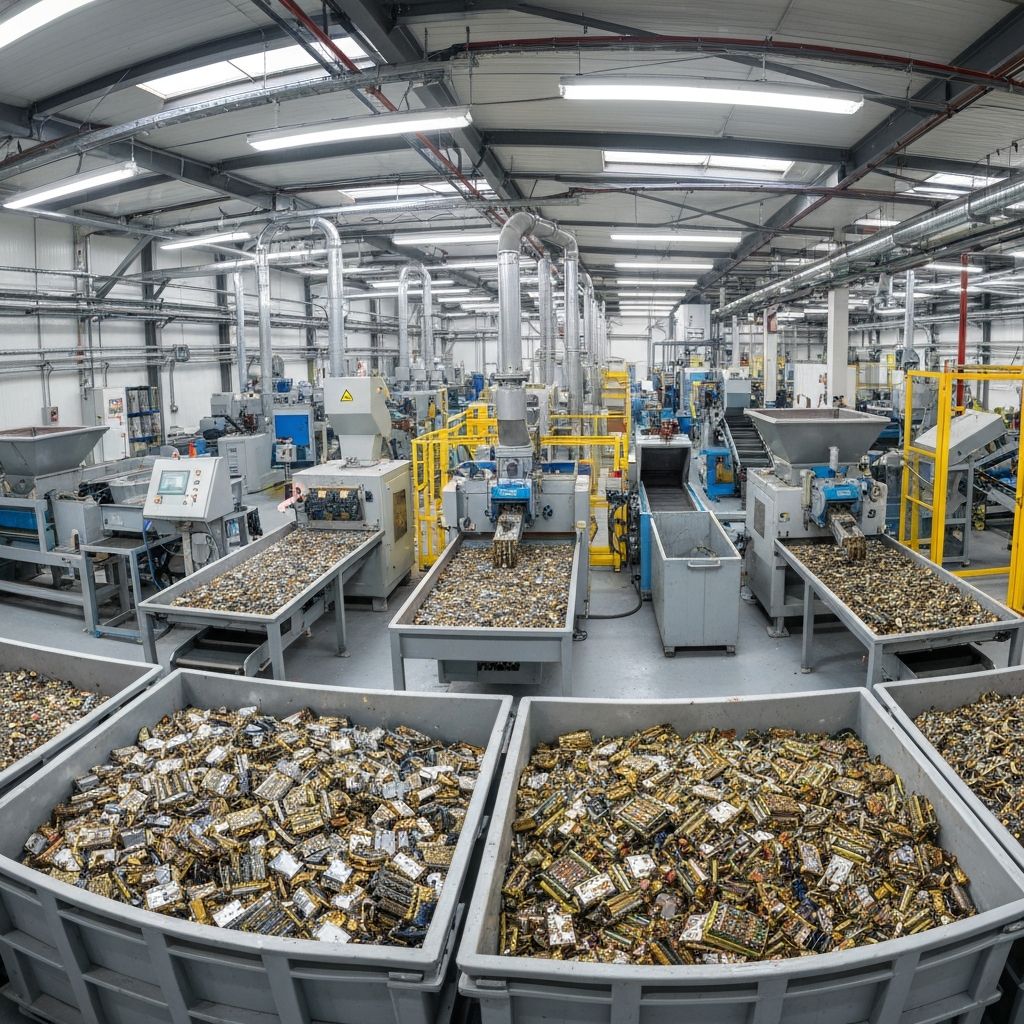
Batteries — They Seem to Be the Solution, But Why?
Because people say you can recycle them?
The narrative goes: we deploy more renewables (solar, wind), but since they're intermittent we need storage — enter batteries. They can shoulder that storage role, smoothing supply, shifting load, matching demand with clean generation. Furthermore, we hear: "And by the way, the battery can be recycled," which makes the story sound circular and sustainable.
But if you dig deeper, the picture is more complicated.
CO₂ Emissions of Battery Production
Manufacturing batteries is not climate-free. The production of a typical lithium-ion battery involves mining of ores, refining, electrode manufacturing, cell assembly, pack integration, logistics — each step carrying CO₂ (and other environmental) burdens.
A recent meta-analysis of life-cycle assessments for lithium-ion batteries estimates a median of ~17.63 kg CO₂-e per kg of battery, standard deviation ~7.34.
To put that into more familiar terms: if a battery pack weighs say 500 kg (which is plausible for a larger EV), that corresponds to ~8,800 kg of CO₂ (17.63 × 500) just for the cell manufacturing up to gate (before use).
Other studies indicate that battery manufacturing can add 40-60% or more of the CO₂ relative to a conventional vehicle.
Thus: yes, batteries help the transition — but they come with an upfront emissions "investment" that needs to be paid back during their use.
Different Battery Technologies
There isn't just one battery type. We should separate out current mainstream technologies and emerging alternatives.
Mainstream Battery Chemistries
- Lithium-ion (Li-ion) in its many variants: e.g., NMC (Nickel-Manganese-Cobalt) chemistry, LFP (Lithium-Iron-Phosphate).
- NMC: higher energy density, uses nickel & cobalt (and manganese) → good for vehicles where weight/volume matter.
- LFP: no cobalt (or much less), iron/phosphate instead — somewhat lower energy density, but cost and supply chain advantages.
- There are also legacy or niche types (lead-acid, NiMH) but for large-scale renewables and EV storage the focus is on Li-ion.
Emerging/Next-Gen Technologies
- Sodium-ion batteries: Use sodium instead of lithium, potentially cheaper and less resource-constrained (since sodium is abundant). But lower energy density so far.
- Solid-state batteries: Use a solid electrolyte rather than a liquid one; offer potential for higher energy density, safety improvements, but still not mass commercial at scale.
- Flow batteries: For stationary storage particularly, liquid electrolyte storage can be more scalable for grid applications (though not always in the "battery pack in a car" sense).
In short: battery technology is evolving, but the dominant workhorses today remain lithium-ion variants.
Critical Minerals & Mining Challenges
Batteries depend on specific materials (minerals) whose sourcing carries environmental, social, and geopolitical challenges.
Key Minerals Commonly Used
- Lithium – essential for traditional Li-ion battery cathodes/anodes.
- Cobalt – notably in many NMC chemistries (though efforts are underway to reduce it).
- Nickel – again especially in higher energy density chemistries (NMC, NCA).
- Manganese – used in some cathode mixes.
- Graphite – for the anode (often natural graphite; synthetic alternatives exist).
- Iron and phosphate (for LFP chemistry).
- In the future: sodium, aluminium, etc, may come more into play.
Why Mining Is Problematic
- Cobalt: Mining is often concentrated in places with weak governance, environmental issues, human-rights concerns (e.g., in the Democratic Republic of Congo). This raises ethical & supply chain risk.
- Lithium: While more geographically spread, extraction (brine, hard rock) often uses large volumes of water (especially in arid regions such as parts of South America), and processing can produce significant CO₂ and other pollutants.
- Nickel: High-grade nickel suitable for batteries involves environmental hazards (mining, refining) and often significant CO₂ emissions depending on electricity mix.
- Graphite: Natural graphite mining can involve considerable environmental disturbance; synthetic graphite uses fossil energy in manufacture.
The Recycling Reality Check
Recycling is often presented as the "closing of the loop" – capturing the minerals, reducing mining, lowering net environmental impact. But the reality is trickier.
In Europe, according to studies, the cost of recycling was estimated at around US$62/kWh in 2020 (Europe) vs US$32/kWh in China. The Opex (operational expenses) for recycling NMC811 cell packs at integrated plants in Europe are around US$14/kWh, compared to US$11/kWh in China; for LFP recycling Europe ~US$7/kWh vs China ~US$4.5/kWh.
So in many cases recycling is not yet profitable without subsidies or without significant scale.
In other words: yes, technically batteries can be recycled; but the industrial, economic, logistical and regulatory ecosystem is still catching up, and large volumes of batteries still are not yet recycled in a fully circular way.
Short-Term Thinking
We introduce new technologies (such as novel battery chemistries or massive rollout of battery storage) often with enthusiasm and speed — inertia, business opportunity, climate urgency drive it. But we frequently neglect the full lifecycle: the end-of-life, the recycling, the resource loops.
If we invest in battery factories and mining and infrastructure now, but leave the recycling and secondary-use infrastructure weak, the result is that we produce a growing stock of batteries that will become waste or be down-cycled poorly, rather than truly closing the loop.
Thus: we should only introduce or scale new technologies when we can guarantee that their full life is thought through — manufacture → use → reuse → recycle → resource return.
A European Example: cylib
Let's profile this company as an example of how the recycling piece is evolving.
About cylib
- Founded in 2022 in Aachen, Germany, as a spin-out from RWTH Aachen University by Dr Lilian Schwich, Paul Sabarny, and Dr Gideon Schwich.
- Developed a proprietary process for end-to-end recycling of lithium-ion batteries with reportedly up to >90% recycling efficiency for key materials (lithium, graphite, nickel, cobalt, manganese).
- Claims an 80% reduction in carbon footprint (for the recycling process) compared to primary extraction of raw materials.
- Closed a €55 million Series A funding round in 2024, the largest for a European battery recycler to date.
- Building a large industrial-scale recycling facility at the CHEMPARK Dormagen chemical site scheduled to commence operations around 2027, with annual capacity around 30,000 tons of end-of-life batteries/year.
Why This Matters
- cylib exemplifies a shift from "we'll worry about recycling later" to "let's build the recycling infrastructure now in parallel".
- By recovering lithium, graphite, nickel, etc at high efficiency, cylib helps make the "recycle" narrative credible rather than merely theoretical.
- Because they are European, their work strengthens resilience (less import-dependence on raw materials from far abroad) and may reduce logistics and emissions tied to transporting scrap overseas for processing.
- If they reach industrial scale and cost parity, they help close the loop — which is essential to make batteries truly sustainable, not just "less bad".
Final Reflection
Batteries are a key enabler of our renewable-energy future. They offer flexibility, storage, decarbonisation potential. But we must be honest: they carry upfront CO₂ emissions, rely on mining of critical minerals, and—so far—lack fully mature recycling/closed-loop ecosystems.
If we treat batteries as a "silver bullet" without scrutinising every stage (mining → manufacture → use → end-of-life → recycle), we risk locking in new dependencies and burdens. The example of cylib shows the way forward: building recycling now, designing the loop, not just the front end.
In short: yes, batteries can be recycled — but "can" isn't the same as "are, at scale, being recycled (cost-efficiently, at high recovery, with minimal environmental impact)". Our job is to make sure the latter becomes reality before we scale hundreds of gigawatt-hours of battery manufacturing without full circularity.