The Hidden Cost of Our Batteries: When Recycling Becomes Exploitation
In our rush to shift to electric vehicles, renewable energy storage and portable electronics, we often hear about the promise of batteries. But what gets far less attention is this: batteries rely on very critical resources — and how we handle them today affects not just the environment, but human rights, health and justice.
Why Batteries Use Critical Resources
Different types of batteries draw on different minerals, many of them scarce, geopolitically concentrated or environmentally damaging to extract. A few examples:
- Lead-acid batteries (common in car starters, backup power) require lead, plus sulphuric acid and various lead alloys.
- Lithium-ion batteries (used in phones, laptops, EVs) typically require lithium, cobalt, nickel, manganese, graphite, and sometimes rare earths or copper.
- Solid-state battery technologies (emerging) may further draw on advanced materials: lithium, silicon, sulphur, sometimes heavy metals.
- Nickel-metal hydride batteries (still used in some hybrid vehicles) rely on nickel, rare earths, cadmium in older variants.
These minerals are "critical" for a reason: they are vital for modern clean-energy and electronics systems, but their supply chains are often fragile, concentrated in a few regions, and carry significant environmental and social risks.
The Case for Recycling Over Mining
Given how crucial these minerals are, it makes sense to ask: instead of constantly going out to win new mineral deposits, why not recycle more of what we have? The logic is compelling:
Environmental Benefits
Recycling reduces demand for fresh mining, which involves habitat destruction, water pollution, and CO₂ emissions.
Supply Chain Security
Reduces dependency on geopolitically risky supply chains and improves material circularity.
Community Protection
Reduces the burden on communities living near mines or smelters who bear health and environmental costs.
High Recovery Rates
Good recycling can recover up to 97% of raw materials from lead-acid batteries under proper conditions.
In principle, then, recycling sounds like a win-win: less mining, less waste, lower costs, less strain on people and planet.
But: Recycling Must Not Be Done at Any Cost
Here's the catch — while recycling is certainly desirable, it must not be seen as an unqualified good. It must be done right. If it isn't, we risk transferring the burden from one extractive site to another, from one community to another, from one generation to another.
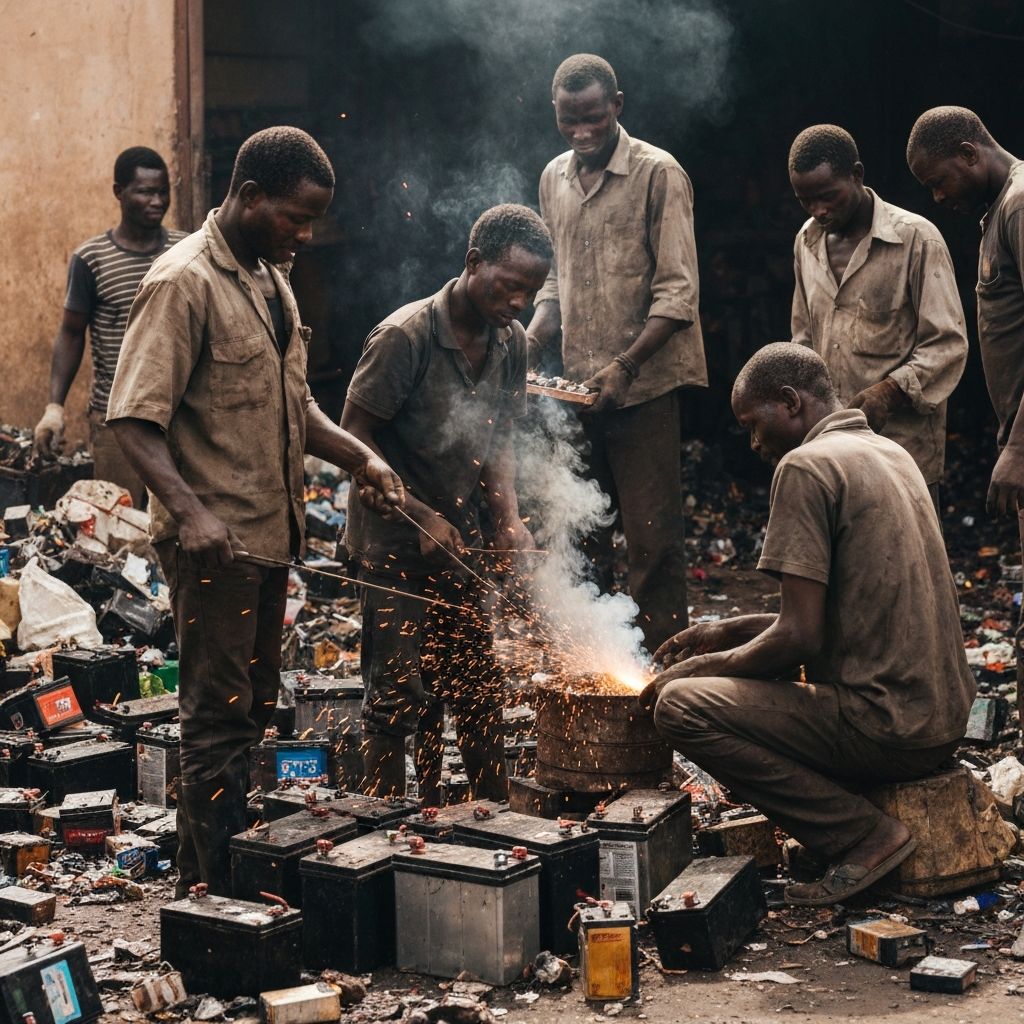
For example, informal recycling of lead-acid batteries in many parts of Africa and the Global South has caused tremendous harm. Workers dismantle old batteries, drain acid into the ground, melt lead plates in makeshift furnaces — and release toxic lead into the air, soil and water.
"Workers buy old batteries, crack them open, drain the acid on the ground, then melt down the lead plates in makeshift furnaces."
These operations are dangerous, expose children and adults to neurotoxins, impair cognitive development, and contaminate entire communities. In some places, elevated lead levels are found in children at rates comparable to the infamous Flint, Michigan water crisis.
The Reality Check
Recycling that overlooks labour rights, worker safety, toxic emissions, environmental justice and community consent is simply shifting harm, not eliminating it.
What We Need to Remember
A recent investigation by The New York Times (November 18, 2025) titled "Lead Poisoning From Car Batteries" highlights one of the stark realities of battery-resource chains: that the extraction, processing and disposal of "spent" batteries still rely on vulnerable communities, informal operations, and carry serious human and environmental costs.
It reminds us that turning to recycling is necessary, but that we must ask: how is it happening, who is bearing the burden, and what standards are we enforcing?
A Path Forward
In the end: the transition to electric, battery-based systems offers huge promise — but it also demands responsibility. Recycling must be sustainable: not only technically efficient, but socially just and environmentally sound.
That means respect for human rights, safe working conditions, accountable supply chains, and care for communities often overlooked. It means we should feel responsible for what we are doing — for the people and planet behind the minerals, the batteries, the recycled materials.
It's time to act with integrity, to demand recycling that honours lives and ecosystems — not at the cost of others, but as part of a just and equitable future.