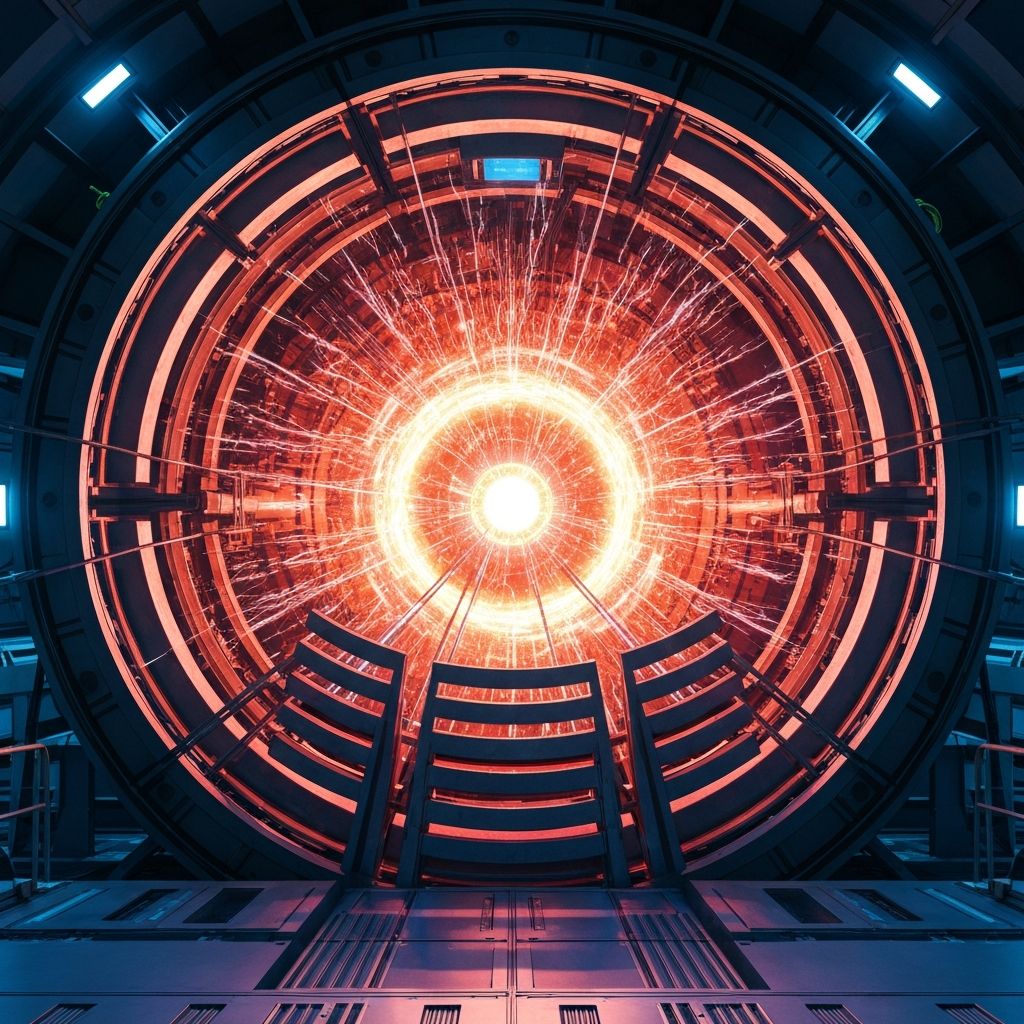
The Race for Nuclear Fusion: Powering a Cleaner Future
Nuclear fusion has long been seen as the ultimate energy goal — a clean, virtually limitless power source that could transform the way we fuel our world. By replicating the same reaction that powers the sun, fusion could offer a future where energy is abundant, safe, and sustainable.
But while the promise is extraordinary, so are the challenges. The race to achieve practical nuclear fusion is one of humanity's most ambitious scientific and engineering endeavors.
What Exactly Is Nuclear Fusion?
Fusion occurs when two light atomic nuclei — typically isotopes of hydrogen such as deuterium and tritium — combine to form a heavier nucleus, releasing a tremendous amount of energy in the process. Unlike nuclear fission, which splits atoms apart, fusion produces minimal radioactive waste and no carbon emissions.
In essence, fusion is a way of turning a small amount of matter directly into energy — cleanly and efficiently.
Why Fusion Matters
Our world is hungry for energy. Global demand continues to grow as we electrify industries, transportation, and cities. At the same time, the pressure to reduce carbon emissions is more urgent than ever.
Fusion offers an elegant solution:
- Clean energy: Fusion reactions produce no greenhouse gases and leave behind only small amounts of short-lived radioactive material.
- Abundant fuel: The primary fuels — hydrogen isotopes found in seawater and lithium — are plentiful and widely available.
- Safety: Unlike fission, fusion does not risk meltdowns or long-term radioactive contamination.
- Scalability: In theory, fusion could provide enough energy to power the planet for millions of years.
The Challenges Ahead
Despite its appeal, fusion remains a formidable technical challenge. To achieve and sustain fusion on Earth, three conditions must be met simultaneously:
- Extreme Temperature – The fuel must be heated to over 100 million degrees Celsius to overcome the natural repulsion between atomic nuclei.
- Confinement – The plasma (a superheated, charged gas) must be contained without touching the reactor walls. This is usually done with powerful magnetic fields (in tokamaks and stellarators) or with intense laser compression (inertial confinement).
- Sufficient Duration – The plasma must remain stable long enough for fusion reactions to release more energy than is consumed to start them.
Researchers have succeeded in producing fusion reactions for short bursts, but achieving a net energy gain — where more energy comes out than goes in — remains elusive in sustained conditions. Even recent breakthroughs, while encouraging, still require massive facilities, extreme precision, and costly infrastructure.
Engineering and Economic Hurdles
Beyond the physics, fusion poses major engineering and economic questions:
- Materials: Reactor walls and internal components must withstand constant bombardment by high-energy neutrons. Developing materials that can survive these conditions is one of the toughest challenges.
- Cost: Building and maintaining fusion reactors is currently far more expensive than conventional or renewable energy sources.
- Scalability: Even if a prototype works, turning it into a reliable, grid-connected power plant is a separate challenge that demands decades of refinement.
The Road Ahead
Despite the obstacles, momentum is growing. Public research projects and private startups alike are racing to crack the fusion code. Massive international collaborations such as ITER in France, and numerous innovative ventures across the U.S., U.K., and Asia, are pushing the boundaries of what's possible.
The timeline for commercially viable fusion power is uncertain — some estimate it could happen within the next two decades, others remain cautious. What's clear is that progress is accelerating, and each breakthrough brings us one step closer to a future powered by the same force that lights the stars.
A Vision Worth Pursuing
Nuclear fusion is more than a scientific milestone; it represents human ingenuity and persistence at their best. It's a testament to our willingness to tackle the hardest problems for the sake of a sustainable, prosperous future.
Whether fusion becomes a cornerstone of global energy or remains an ever-distant dream depends on how we sustain research, innovation, and investment in the years ahead.
What do you think? Could fusion truly be the breakthrough that redefines our energy future — or will other technologies get there first? I'd love to hear your perspective.